Technique
Burr grinder vs blade grinder: what changes in the cup and why
Burr grinder vs blade grinder explained by what each mechanism does to particle size, and why that single difference shows up in extraction.
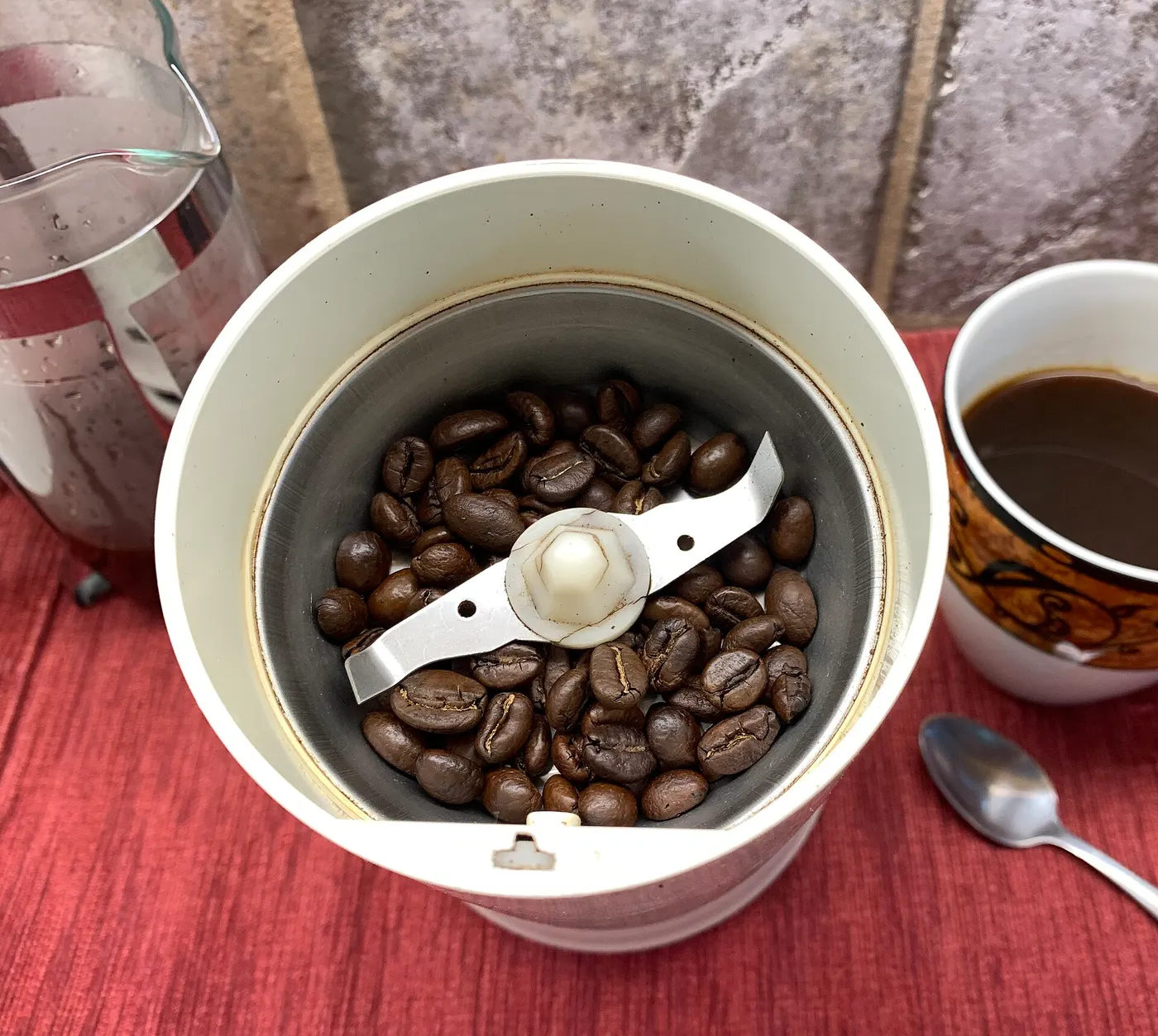
The burr grinder vs blade grinder question has one mechanical answer that explains every other difference. A blade is a rotating knife that fractures beans repeatedly. A burr is a pair of surfaces set a fixed distance apart that beans pass through once. The first produces a wide spread of particle sizes, the second a narrow one.
Two mechanisms, two distributions
A blade grinder reduces beans by impact. Everything in the chamber is struck repeatedly until the operator stops the motor, so some fragments have been hit many times and are nearly dust while others have barely been touched. Grinding longer makes everything finer but does not make it more uniform.
A burr grinder passes beans through a gap between two shaped surfaces. A particle leaves the gap when it is small enough to fit through it, which sets an upper bound on size. The result is a narrower distribution, and the gap is adjustable, which is what makes a setting repeatable.
| Property | Blade | Burr |
|---|---|---|
| How size is determined | By how long the motor runs | By a set gap between surfaces |
| Size distribution | Wide, fines alongside coarse pieces | Narrower, bounded above by the gap |
| Repeatability | Depends on timing by the operator | Depends on a numbered setting |
| Adjustment | Indirect, by duration | Direct, by changing the gap |
Every practical difference people report between the two follows from the first two rows.
Why distribution changes the cup
Extraction is a function of surface area and contact time. Small particles have far more surface area for their mass, so they give up soluble material quickly. Large pieces give it up slowly. When both are present in the same brew, the small particles over-extract while the large ones are still under-extracted.
That is the mechanism behind the common description of blade-ground coffee as simultaneously bitter and sour. It is not a single flavour fault to be corrected by brewing differently. It is two faults at once, produced by the grind rather than the brew, which is why adjusting brew time does not resolve it.
A useful way to picture it is to imagine two brews that both average the correct particle size but reach that average differently. One is made of particles clustered tightly around the average; the other is half dust and half gravel. They have the same mean and behave nothing alike, because extraction does not average out. The dust finishes extracting early and keeps going, releasing compounds that arrive late and taste harsh, while the gravel is still giving up the pleasant early compounds when the brew ends.
- Fine particles extract fast and contribute bitterness when over-extracted
- Coarse pieces extract slowly and contribute sourness when under-extracted
- A wide distribution produces both at once in a single brew
- Changing brew time moves both faults together rather than fixing either
Where the difference matters most
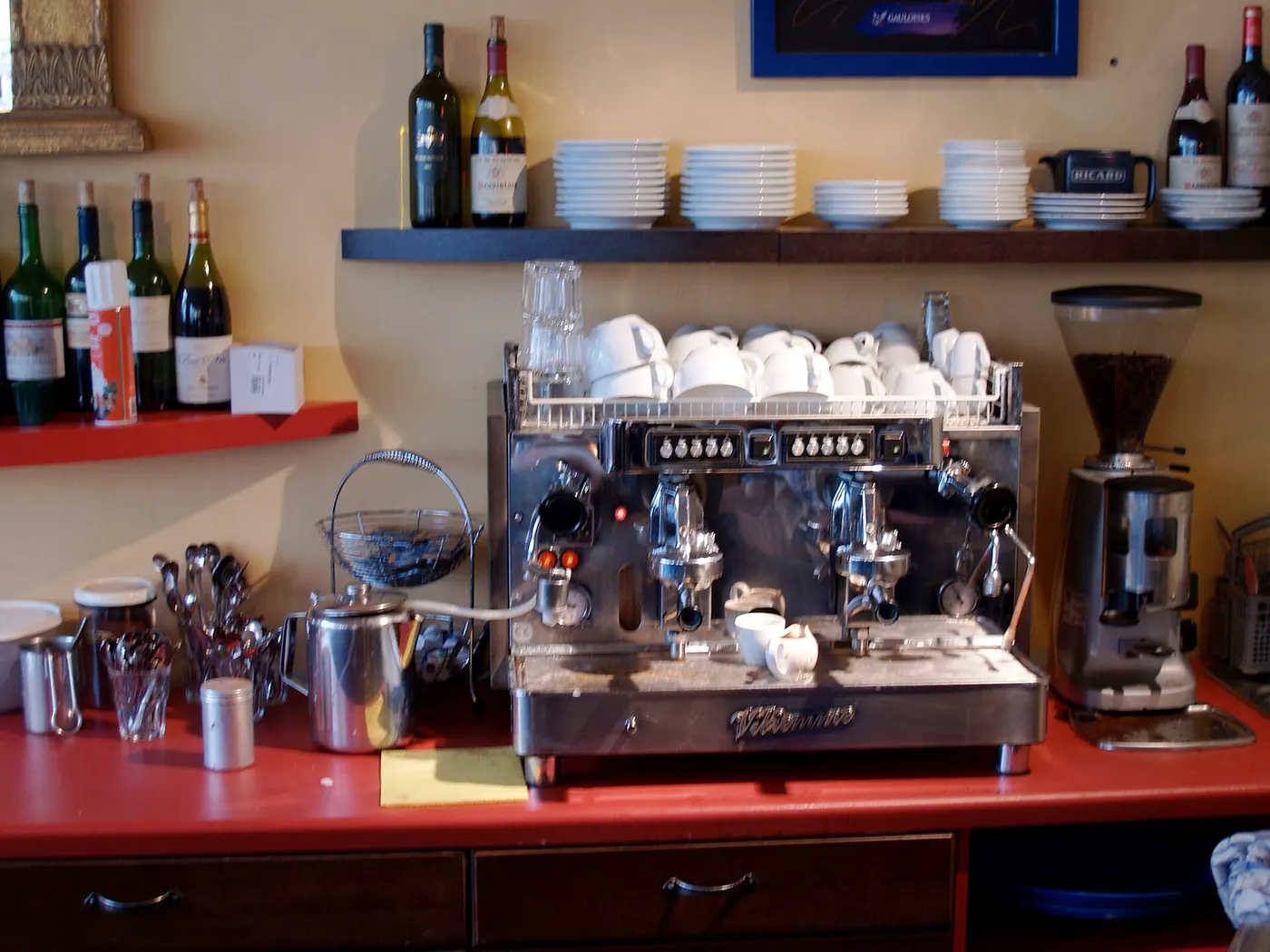
The shorter the contact time, the less tolerant the method is of uneven grind. Espresso has the shortest contact time and the least tolerance, which is why it is effectively impossible with a blade grinder. Immersion methods with long contact times are the most forgiving, because slow-extracting pieces have more time to catch up.
Filter methods sit between the two. The practical implication is that the value of moving from blade to burr is not constant across brewing methods, and it is largest exactly where people most want consistency.
| Method | Relative contact time | Tolerance to wide distribution |
|---|---|---|
| Espresso | Shortest | Very low |
| Filter or pour-over | Moderate | Moderate |
| Immersion, such as a press | Longest | Highest |
Longer contact lets slow pieces catch up. It does not stop fines over-extracting, so a press brewed from blade-ground coffee still carries bitterness.
Burr type and the limits of the category
Burr is not one thing. Flat and conical geometries produce different distributions, and burr material, alignment and motor speed all move the result. Calling a grinder a burr grinder sets a floor on distribution rather than guaranteeing a particular one.
Alignment is the factor most often overlooked. A burr set that is not parallel grinds a different gap on one side than the other, which widens the distribution the geometry was supposed to narrow. On adjustable machines this is serviceable, which is another reason the gap-based mechanism is more repairable in practice.
Retention is the practical issue that gets least attention. Every grinder holds some ground coffee inside it between uses, in the chute, around the burrs and in the exit path. That retained material is stale by the time it leaves, and it leaves mixed into the next dose. On machines used once or twice a day the retained fraction can be a meaningful share of a single dose, which is why some designs are built around minimising it and why single-dosing has become a common workaround.
None of this makes a burr grinder a finished answer. It moves the limiting factor rather than removing it, which is the honest way to describe most equipment decisions in brewing.
- Flat and conical geometries differ in the distribution they produce
- Alignment of the burr set changes the effective gap across the surface
- Motor speed affects heat and, at the margins, fines generation
- Retention between doses carries old grounds into the next brew
What a grinder cannot fix
Grind uniformity does not compensate for stale coffee, incorrect ratio or water that is unsuitable for brewing. The Specialty Coffee Association publishes research and standards work on brewing variables, and grind is one input among several that includes water composition, ratio and temperature.
The National Coffee Association's brewing guidance makes the same point from the other direction: the variables interact, and fixing the least controlled one first gives the largest improvement. For most people using a blade grinder, that variable is the grind, which is why the change is noticeable. After that, it stops being the limiting factor.
Deciding between the two
The decision follows from brewing method and from whether repeatability matters to you.
- Identify your brewing method and its contact time, because that sets how much uniformity is worth
- If you brew espresso, treat a burr grinder as a requirement rather than an upgrade
- If you brew by immersion only, expect a smaller difference than the general discussion suggests
- If you want repeatable results, prefer a numbered gap setting over timing a motor
- Check whether the burr set can be aligned and replaced, because that decides year three
Before you buy
- Identify your brewing method and its contact time before deciding how much grind uniformity is worth
- Treat a burr grinder as a requirement for espresso rather than an optional upgrade
- Prefer a numbered gap setting over timing a motor if you want repeatable results
- Check whether the burr set can be aligned and whether replacement burrs are sold
- Fix the least controlled variable first, then stop treating grind as the limiting factor
Questions readers ask
- Can a blade grinder be used for espresso?
- Not usefully. Espresso has the shortest contact time and the least tolerance for a wide particle distribution, and a blade grinder cannot produce a repeatable setting.
- Does grinding longer with a blade make it more even?
- No. It makes everything finer while keeping the spread wide, because the mechanism has no upper bound on particle size other than how long the motor runs.
- Is a conical burr better than a flat one?
- They produce different distributions rather than a strictly better one. Alignment, burr condition and retention often matter more than the geometry label.
Sources
- Specialty Coffee Association — research — checked 2026-11-06
- National Coffee Association — how to brew coffee — checked 2026-11-06
Some links on this site can earn us a commission. That does not change which product a guide recommends, and it adds nothing to your price. Advertising is not enabled on this site yet. When it is, ads will be labelled and kept visually separate from the guides.